The Blue Helmets a Review of Un Peacekeeping
| United Nations Peacekeeping | |
|---|---|
 | |
| Founded | 1945 (1945) |
| Website | United nations Peacekeeping |
| Leadership | |
| Under-Secretarial assistant-General for Peacekeeping Operations | Jean-Pierre Lacroix |
| Personnel | |
| Agile personnel | 150,000 total[ane] |
| Expenditures | |
| Budget | $half dozen.seven billion |
| Related articles | |
| History | Un peacekeeping missions |
Peacekeeping by the United nations is a office held by the Department of Peace Operations as an "instrument developed past the organization equally a way to help countries torn by conflict to create the weather for lasting peace".[2] Information technology is distinguished from peacebuilding, peacemaking, and peace enforcement although the United nations does acknowledge that all activities are "mutually reinforcing" and that overlap between them is frequent in practice.[3]
Peacekeepers monitor and notice peace processes in post-conflict areas and assistance ex-combatants in implementing the peace agreements they may take signed. Such assist comes in many forms, including confidence-edifice measures, power-sharing arrangements, electoral support, strengthening the rule of law, and economical and social evolution. Accordingly, United nations peacekeepers (often referred to every bit Bluish Berets or Blue Helmets considering of their light blueish berets or helmets) tin can include soldiers, law officers, and civilian personnel.
The United nations Charter gives the Un Security Council the power and responsibility to take collective activity to maintain international peace and security. For this reason, the international community usually looks to the Security Council to qualify peacekeeping operations through Chapter VII authorizations.[4]
Nigh of these operations are established and implemented by the United nations itself, with troops serving under United nations operational control. In these cases, peacekeepers remain members of their corresponding war machine, and practise not constitute an independent "United nations ground forces", as the UN does not have such a force. In cases where direct Un involvement is not considered appropriate or viable, the Quango authorizes regional organizations such as NATO,[four] the Economic Customs of West African States, or coalitions of willing countries to undertake peacekeeping or peace-enforcement tasks.
Jean-Pierre Lacroix is the Head of the Department of Peace Operations; he took over from the former Under-Secretary-General Hervé Ladsous on i Apr 2017. Since 1997, all leaders have been French. DPKO'due south highest level doctrine certificate, entitled "Un Peacekeeping Operations: Principles and Guidelines" was issued in 2008.[5]
Procedure and structure [edit]

Total size of United Nations peacekeeping forces, 1947 to 2014[vi]
In 2007, a peacekeeper volunteer was required to be over the historic period of 25 with no maximum age limit.[vii] Peacekeeping forces are contributed by member states on a voluntary basis. Equally of xxx June 2019[update], at that place are 100,411 people serving in UN peacekeeping operations (86,145 uniformed, 12,932 noncombatant, and 1,334 volunteers).[8] European nations contribute nearly 6,000 units[ clarification needed ] to this total. Pakistan, Republic of india, and Bangladesh are among the largest private contributors with around 8,000 units each. African nations contributed virtually half the total, about 44,000 units.[9] Every peacekeeping mission is authorized past the Security Council.[ citation needed ]
Formation [edit]
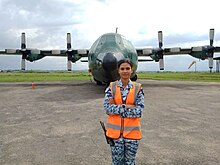
People's republic of bangladesh Emergency Crash and Rescue Department of MONUSCO Force, in Bunia, Ituri.
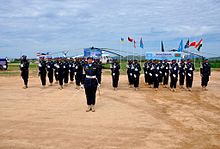
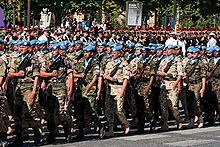
One time a peace treaty has been negotiated, the parties involved might ask the United Nations for a peacekeeping force to oversee diverse elements of the agreed upon programme. This is often washed because a grouping controlled past the United nations is less likely to follow the interests of whatever one political party, since it itself is controlled by many groups, namely the fifteen-member Security Council and the intentionally diverse Un Secretariat.
If the Security Council approves the creation of a mission, so the Department of Peacekeeping Operations begins planning for the necessary elements. At this indicate, the senior leadership team is selected. The department volition and so seek contributions from member nations. Since the Un has no standing force or supplies, it must class advertisement hoc coalitions for every job undertaken. Doing so results in both the possibility of failure to form a suitable strength, and a general slowdown in procurement once the operation is in the field. Roméo Dallaire, force commander in Rwanda during the Rwandan genocide in that location, described the problems this poses past comparison to more traditional military deployments:
He told me the United nations was a "pull" arrangement, not a "push" organization like I had been used to with NATO, considering the Un had absolutely no puddle of resources to draw on. You had to brand a request for everything you needed, so y'all had to await while that request was analyzed... For case, soldiers everywhere accept to eat and potable. In a push organization, nutrient and water for the number of soldiers deployed is automatically supplied. In a pull organisation, yous take to ask for those rations, and no common sense seems to e'er employ.
While the peacekeeping force is being assembled, a variety of diplomatic activities are being undertaken by United nations staff. The exact size and strength of the forcefulness must exist agreed to past the government of the nation whose territory the disharmonize is on. The Rules of Engagement must exist developed and canonical by both the parties involved and the Security Council. These requite the specific mandate and scope of the mission (e.g. when may the peacekeepers, if armed, use force, and where may they go within the host nation). Ofttimes, information technology volition be mandated that peacekeepers have host government minders with them whenever they leave their base. This complexity has acquired bug in the field. When all agreements are in identify, the required personnel are assembled, and final approval has been given by the Security Council, the peacekeepers are deployed to the region in question.
Financing [edit]

The financial resources of UN Peacekeeping operations are the collective responsibility of UN Fellow member States. Decisions about the establishment, maintenance or expansion of peacekeeping operations are taken past the Security Council. According to UN Charter every Fellow member State is legally obligated to pay their respective share for peacekeeping. Peacekeeping expenses are divided past the General Associates based upon a formula established by Member States which takes into account the relative economic wealth of Member States among other things.[10] In 2017, the UN agreed to reduce the peacekeeping budget by $600 million after the US initially proposed a larger cut of approximately $900 meg.[xi]
| Year | Funding sources by country/source | Description | Total |
|---|---|---|---|
| 2015–2016 | $8.3bn[12] | ||
| 2016–2017 |  US 28.57% US 28.57% | Less than 0.v% of world military expenditures (estimated at $1,747 billion in 2013). The resources financed 14 of the sixteen Un peacekeeping missions with the two remaining ones getting financed through the UN regular budget. Many countries have also voluntarily fabricated additional resource available to back up UN Peacekeeping efforts such equally by transportation, supplies, personnel and financial contributions beyond their assessed share of peacekeeping costs.[10] | $seven.87bn[x] |
| 2017–2018 | While many take praised the Republic of cote d'ivoire UN peacekeeping mission's stabilizing effects on the land, the mission was ended on 30 June 2017.[13] | $7.3bn[11] |


The Full general Associates approves resources expenditures for peacekeeping operations on a yearly basis. Financing covers the menstruation from 1 July to thirty June of the following year.
| Acronym | Performance | 2017–2018 | 2018–2019 |
|---|---|---|---|
| UNMISS | Mission in South Sudan | $1,071,000,000 | $1,124,960,400 |
| MONUSCO | Stabilization Mission in the Congo | $1,141,848,100 | $1,114,619,500 |
| MINUSMA | Stabilization Mission in Mali | $1,048,000,000 | $1,074,718,900 |
| MINUSCA | Stabilization Mission in the Cardinal African Commonwealth | $882,800,000 | $930,211,900 |
| UNSOS | Support Role in Somalia | $582,000,000 | $558,152,300 |
| UNIFIL | Interim Force in Lebanon | $483,000,000 | $474,406,700 |
| UNAMID | Mission in Darfur | $486,000,000 | $385,678,500 |
| UNISFA | Interim Security Force for Abyei | $266,700,000 | $263,858,100 |
| UNMIL | Mission in Republic of liberia | $110,000,000 | - |
| MINUJUSTH | Mission for Justice Back up in Haiti | $90,000,000 | $121,455,900 |
| UNDOF | Disengagement Observer Force | $57,653,700 | $60,295,100 |
| UNFICYP | Peacekeeping Forcefulness in Republic of cyprus | $54,000,000 | $52,938,900 |
| MINURSO | Mission for the Plebiscite in Western Sahara | $52,000,000 | $52,350,800 |
| UNMIK | Interim Administration Mission in Kosovo | $37,898,200 | $37,192,700 |
| Year Total | $6,362,900,000 | $6,250,839,700 |
Structure [edit]
A Un peacekeeping mission has three power centers. The outset is the Special Representative of the Secretarial assistant-Full general, the official leader of the mission. This person is responsible for all political and diplomatic activeness, overseeing relations with both the parties to the peace treaty and the United nations fellow member-states in general. They are oftentimes a senior member of the Secretariat. The 2d is the Strength Commander, who is responsible for the armed services forces deployed. They are a senior officeholder of their nation's military, and are oft from the nation committing the highest number of troops to the projection. Finally, the Main Administrative Officer oversees supplies and logistics, and coordinates the procurement of any supplies needed.[ citation needed ]
History [edit]
Cold War peacekeeping [edit]

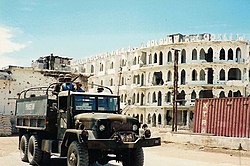
A Pakistani UNOSOM armed convoy making the rounds in Mogadishu.
United nations peacekeeping was initially developed during the Cold State of war as a means of resolving conflicts between states by deploying unarmed or lightly armed armed services personnel from a number of countries, nether UN command, to areas where warring parties were in need of a neutral party to observe the peace process. Peacekeepers could be called in when the major international powers (the v permanent members of the Security Council) tasked the UN with bringing closure to conflicts threatening regional stability and international peace and security. These included a number of and so-called "proxy wars" waged by customer states of the superpowers. Equally of December 2019, there have been 72 UN peacekeeping operations since 1948, with seventeen operations ongoing. Suggestions for new missions arise every twelvemonth.
The first peacekeeping mission was launched in 1948. This mission, the United Nations Truce Supervision Organisation (UNTSO), was sent to the newly created Country of Israel, where a conflict betwixt the Israelis and the Arab states over the creation of Israel had merely reached a ceasefire. The UNTSO remains in performance to this day, although the Israeli–Palestinian conflict has certainly not abated. Almost a year later on, the Un Military Observer Group in India and Pakistan (UNMOGIP) was authorized to monitor relations between the two nations, which were split off from each other post-obit the United Kingdom'southward decolonization of the Indian subcontinent.
Equally the Korean War concluded with the Korean Armistice Agreement in 1953,[16] UN forces remained along the south side of demilitarized zone until 1967, when American and South Korean forces took over.[ citation needed ]
Returning its attending to the disharmonize between Israel and its Arab neighbors, the Un responded to Suez Crisis of 1956, a war betwixt the brotherhood of the United Kingdom, French republic, and Israel, and Egypt, which was supported by other Arab nations. When a ceasefire was declared in 1957, Canadian Secretary of Land for External Affairs[17] (and future Prime Government minister) Lester Bowles Pearson suggested that the United Nations station a peacekeeping force in the Suez in order to ensure that the ceasefire was honored by both sides. Pearson had initially suggested that the force consist of mainly Canadian soldiers, but the Egyptians were suspicious of having a Commonwealth nation defend them against the U.k. and her allies. In the stop, a broad diverseness of national forces were drawn upon to ensure national variety. Pearson would win the Nobel Peace Prize for this piece of work, and he is today considered a begetter of modernistic peacekeeping.[ citation needed ]
In 1988, the Nobel Peace Prize was awarded to the United Nations peacekeeping forces. The press release stated that the forces "correspond the manifest will of the community of nations" and have "made a decisive contribution" to the resolution of conflict effectually the world.
Since 1991 [edit]
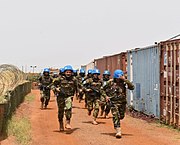
Bangladesh forces under MINUSMA Republic of mali.

The end of the Cold War precipitated a dramatic shift in Un and multilateral peacekeeping. In a new spirit of cooperation, the Security Council established larger and more complex Un peacekeeping missions, often to help implement comprehensive peace agreements between belligerents in intra-State conflicts and civil wars. Furthermore, peacekeeping came to involve more and more non-armed forces elements that ensured the proper operation of borough functions, such as elections. The UN Section of Peacekeeping Operations was created in 1992 to support this increased demand for such missions.
By and large, the new operations were successful. In El Salvador and Mozambique, for instance, peacekeeping provided ways to achieve self-sustaining peace. Some efforts failed, perhaps as the result of an overly optimistic cess of what United nations peacekeeping could achieve. While circuitous missions in Cambodia and Mozambique were ongoing, the Security Council dispatched peacekeepers to conflict zones like Somalia, where neither ceasefires nor the consent of all the parties in conflict had been secured. These operations did not have the manpower, nor were they supported past the required political will, to implement their mandates. The failures—most notably the 1994 Rwandan genocide and the 1995 massacre in Srebrenica and Republic of bosnia and herzegovina—led to a menstruation of retrenchment and self-test in UN peacekeeping. As a upshot, relatively small UNTAES transitional administration in Eastern Slavonia received high level of commitments and was turned into "proving basis for ideas, methods, and procedures".[xviii] It turned out to exist labeled as the most successful UN missions and was followed past other more than aggressive transitional administrations in Kosovo (UNMIK) and Democratic republic of timor-leste (UNTAET).
That period led, in function, to the United Nations Peacebuilding Commission, which works to implement stable peace through some of the aforementioned borough functions that peacekeepers likewise piece of work on, such as elections. The Commission currently works with six countries, all in Africa.[19]
Participation [edit]
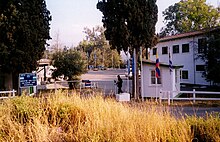
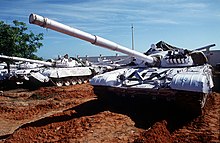
The UN Lease stipulates that to assist in maintaining peace and security effectually the world, all member states of the UN should make available to the Security Council necessary armed forces and facilities. Since 1948, close to 130 nations have contributed armed services and civilian police personnel to peace operations. While detailed records of all personnel who take served in peacekeeping missions since 1948 are not available, it is estimated that up to ane million soldiers, law officers and civilians have served under the UN flag in the last 56 years. As of June 2013, 114 countries were contributing a total 91,216 war machine observers, police, and troops to United Nations Peacekeeping Operations.
As of 31 August 2020, 120 countries were contributing a total of 81,820 personnel in Peacekeeping Operations, with Bangladesh leading the tally (vi,731), followed by Ethiopia (6,662) and Rwanda (6,322).[1] In June 2013. Pakistan contributed the highest number overall with 8000 personnel, followed past India (9000), Bangladesh (seven,799), Ethiopia (half dozen,502), Rwanda (4,686), Nigeria (4,684), Nepal (4,495), Jordan (three,374), Ghana (2,859), and Egypt (2,750).[20] As of 28 Feb 2015, 120 countries were contributing a total of 104,928 personnel in Peacekeeping Operations, with People's republic of bangladesh leading the tally (9,446).[21] As of March 2008, in improver to military and police personnel, 5,187 international noncombatant personnel, ii,031 Un Volunteers and 12,036 local civilian personnel worked in United nations peacekeeping missions.[22]

Through October 2018, iii,767 people from over 100 countries had been killed while serving on peacekeeping missions.[23] Many of those came from Republic of india (163), Nigeria (153), Pakistan (150), People's republic of bangladesh (146), and Ghana (138).[24] 30 pct of the fatalities in the showtime 55 years of Un peacekeeping occurred in the years 1993-1995. About iv.5% of the troops and noncombatant law deployed in UN peacekeeping missions come from the European union and less than one per centum from the U.s. (USA).[25]
The rate of reimbursement by the UN for troop-contributing countries per peacekeeper per month include: $1,028 for pay and allowances; $303 supplementary pay for specialists; $68 for personal wearable, gear and equipment; and $5 for personal weaponry.[26]
United States [edit]
In the United States, the Bill Clinton and George W. Bush-league administrations started from opposite perspectives only came to adopt remarkably similar policies in back up of peace operations as tools for American strange policy. Initial positions formed past ideological concerns, were replaced by pragmatic decisions well-nigh how to support UN peace operations. Both administrations were reluctant to contribute large contingents of ground troops to United nations-commanded operations, even as both administrations supported increases in the number and calibration of Un missions.[27]
The Clinton administration faced significant operational challenges. Instead of a liability, this was the tactical toll of strategic success. American peace operations help transform its NATO alliance. The George Due west. Bush-league administration started with a negative ideological attitude toward peace operations. However European and Latin American governments emphasized peace operations equally strategically positive, peculiarly regarding the use of European forces in Afghanistan and Lebanon. Still American allies sometimes needed to flout their autonomy, even to the point of sacrificing operational efficiency, much to the annoyance of Washington.[28]
Results [edit]
According to scholar Page Fortna, there is strong evidence that the presence of peacekeepers significantly reduces the adventure of renewed warfare; more peacekeeping troops leads to fewer battlefield and civilian deaths.[29] At that place is as well evidence that the promise to deploy peacekeepers can help international organizations in bringing combatants to the negotiation table and increment the likelihood that they volition agree to a cease-fire.[30]
All the same, there take been several reports during United nations peacekeeping missions of homo rights abuse by United nations soldiers, notably in Fundamental African Republic in 2015. The toll of these missions is as well pregnant, with UNMISS in Southward Sudan costing $1 billion per year for 12,500 UN soldiers unable to prevent the state's movement towards civil war. Often missions crave approval from local governments before deploying troops which can also limit effectiveness of Un missions.[31]
Nicholas Sambanis asserts that the presence of a UN peacekeeping mission is correlated with a positive effect on the achievement of peace, especially in the short-term. However, he notes that this effect is lessened over time. Thus, the longer that peacekeepers remain in a state, the greater the likelihood that peace will maintain. Acknowledging the success that UN peacekeeping operations have achieved in increasing political participation, Sambanis claims that a greater focus on economic development would further increment the efficacy of peacekeeping efforts.[32]
Some other report suggests that doubling the peacekeeping operation upkeep, stronger peacekeeping operation mandates and a doubling of the PKO budget would reduce armed conflicts by up to two thirds relative to a scenario without PKOs.[33] An analysis of 47 peace operations past Virginia Page Fortna of Columbia University constitute that the involvement of UN personnel generally resulted in enduring peace.[34] Political scientists Hanne Fjelde, Lisa Hultman and Desiree Nilsson of Uppsala University studied twenty years of data on peacekeeping missions, including in Lebanon, the Congo-kinshasa, and the Fundamental African Republic, and concluded that they were more than constructive at reducing civilian casualties than counterterrorism operations by nation states.[35]
A 2021 study in the American Political Scientific discipline Review found that the presence of UN peacekeeping missions had a weak correlation with rule of police while disharmonize is ongoing, but a robust correlation during periods of peace. The study also found that "the relationship is stronger for noncombatant than uniformed personnel, and is strongest when UN missions engage host states in the procedure of reform."[36] As well, Georgetown University professor Lise Howard argues that UN peacekeeping operations are more effective past virtue of their lack of compelling strength; rather, their use of nonviolent methods such as "verbal persuasion, financial inducements and coercion short of offensive armed services forcefulness, including surveillance and abort" are likelier to pacify warring parties.[37]
A 2021 study in the American Journal of Political Science found that UN peacekeeping in South Sudan had a positive impact on the local economy.[38]
According to a 2011 study, UN peacekeeping missions were most probable to exist successful if they had support and consent from domestic actors in the host state.[39]
Peacekeeping and cultural heritage [edit]
The Un Peacekeeping's commitment to protecting cultural heritage dates dorsum to 2012, when there was extensive destruction in Mali. In this affair, the protection of a country's cultural heritage was included in the mandate of a United nations mission (Resolution 2100) for the first time in history. In addition to many other advances, Italy signed an understanding with UNESCO in Feb 2016 to create the earth's first emergency task force for culture, made up of civilian experts and the Italian Carabinieri. On the ane hand, Un Peacekeeping trained its personnel with regard to the protection of cultural belongings and, on the other hand, there was intensive contact with other organizations concerned with it. The "Blue Helmet Forum 2019" was ane of those events where the actors involved exchanged their previous experiences and tried to strengthen the cooperation. An outstanding mission was the deployment of the Un peace mission UNIFIL together with Blue Shield International in 2019 to protect the UNESCO World Heritage in Lebanon. Information technology was shown that cultural property protection (carried out by war machine and civil specialists) forms the bones footing for the time to come peaceful and economic development of a city, region or land in many conflict zones. The demand for preparation and coordination of the military machine and civilian participants, including the increased interest of the local population, became credible. Later on the explosion in Beirut in 2020, the blue helmets were able to take extensive relief measures together with Blue Shield International and the Lebanese Army.[46]
Crimes by peacekeepers [edit]
Peacekeeping, human trafficking, and forced prostitution [edit]
Reporters witnessed a rapid increase in prostitution in Cambodia and Mozambique after UN peacekeeping forces moved in. In the 1996 UN written report "The Impact of Armed Conflict on Children", the former outset lady of Mozambique Graça Machel documented: "In vi out of 12 state studies on sexual exploitation of children in situations of armed conflict prepared for the present report, the arrival of peacekeeping troops has been associated with a rapid ascent in child prostitution."[47]
Gita Sahgal spoke out in 2004 virtually the fact that prostitution and sex corruption crops upwardly wherever humanitarian intervention efforts are set up. She observed: "The outcome with the UN is that peacekeeping operations, unfortunately, seems to exist doing the same thing that other militaries do. Even the guardians have to exist guarded."[48]
Human rights violations in Un missions [edit]
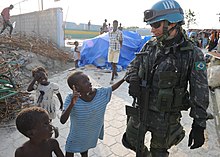
The post-obit table chart illustrates confirmed accounts of crimes and human rights violations committed past Un soldiers, peacekeepers, and employees.[61]
| Conflict | United Nations Mission | Sexual corruption | Murder | Extortion/Theft |
|---|---|---|---|---|
| Second Congo War | Un Mission in the Democratic Republic of Congo | 150 | 3 | 44 |
| Somali Civil State of war | United nations Operation in Somalia Ii | five | 24 | v |
| Sierra Leone Civil War | United Nations Mission in Sierra Leone | 50 | 7 | xv |
| Eritrean-Ethiopian War | United nations Mission in Ethiopia and Eritrea | 70 | 15 | 0 |
| Burundi Civil State of war | United Nations Performance in Burundi | fourscore | 5 | 0 |
| Rwanda Civil War | United Nations Observer Mission Uganda-Rwanda | 65 | fifteen | 0 |
| Second Liberian Ceremonious State of war | United Nations Mission in Liberia | 30 | 4 | 1 |
| Second Sudanese Civil War | Un Mission in Sudan | 400 | 5 | 0 |
| Côte d'Ivoire Civil War | United nations Functioning in Côte d'Ivoire | 500 | 2 | 0 |
| 2004 Haitian coup d'état | United Nations Stabilization Mission in Haiti | 110 | 57 | 0 |
| Kosovo War | Un Interim Assistants Mission in Kosovo | 800 | lxx | 100 |
| Israeli–Lebanese conflict | United nations Interim Force in Lebanon | 0 | vi | 0 |
Proposed reform [edit]
Brahimi analysis [edit]
In response to criticism, peculiarly of the cases of sexual abuse by peacekeepers, the United nations has taken steps toward reforming its operations. The Brahimi Report was the first of many steps to recap former peacekeeping missions, isolate flaws, and take steps to patch these mistakes to ensure the efficiency of time to come peacekeeping missions. The UN has vowed to continue to put these practices into effect when performing peacekeeping operations in the future. The technocratic aspects of the reform process take been connected and revitalised by the DPKO in its "Peace Operations 2010" reform calendar. This included an increment in personnel, the harmonization of the conditions of service of field and headquarters staff, the development of guidelines and standard operating procedures, and improving the partnership system between the Department of Peacekeeping Operations (DPKO) and the Un Development Plan (UNDP), African Union and European Marriage. 2008 capstone doctrine entitled "United nations Peacekeeping Operations: Principles and Guidelines"[5] incorporates and builds on the Brahimi analysis.
Rapid reaction force [edit]
One suggestion to account for delays such equally the one in Rwanda, is a rapid reaction force: a standing grouping, administered by the UN and deployed by the Security Quango, that receives its troops and support from current Security Quango members and is set for quick deployment in the outcome of future genocides.[62]
Restructuring of the UN secretariat [edit]
The UN peacekeeping capacity was enhanced in 2007 by augmenting the DPKO with the new Department of Field Support (DFS). Whereas the new entity serves as a key enabler past co-ordinating the administration and logistics in UN peacekeeping operations, DPKO concentrates on policy planning and providing strategic directions.[ citation needed ]
Partnership for Technology in Peacekeeping [edit]
The Partnership for Technology in Peacekeeping initiative was established in 2014 by the Information and Communications Technology Division of the former Section of Field Support (DFS) with an objective to bring greater involvement to peacekeeping through innovative approaches and technologies that have the potential to empower UN global operations.[63]
The Partnership for Technology in Peacekeeping holds annual symposiums. The 5th International Partnership for Applied science in Peacekeeping Symposium was held in Nur-Sultan, Republic of kazakhstan from 28 to 31 May 2019. It was the showtime time the Key Asian country held such event on peacekeeping. Jean-Pierre Lacroix, United nations Under-Secretary-Full general for Peacekeeping Operations, and Atul Khare, Un Nether-Secretary-General for Field Support, participated in the symposium.[64]
Encounter also [edit]
- UN Department of Peacekeeping Operations
- International Day of United nations Peacekeepers
- List of United Nations peacekeeping missions
- List of countries by number of United nations peacekeepers
- Multinational Force and Observers
- Timeline of Un peacekeeping missions
- Listing of non-UN peacekeeping missions
- NATO peacekeeping
- White Helmets Commission
- PKSOI
- International security
- Responsibility to protect
- Security-related bills
References [edit]
- ^ a b https://peacekeeping.un.org/sites/default/files/01_summary_of_contributions_28.pdf[ bare URL PDF ]
- ^ United Nations Peacekeeping
- ^ "Peace and Security". Un . Retrieved 2017-05-xviii .
- ^ a b Nau, Henry (2015). Perspectives on International Relations. Washington DC: CQ Press. pp. 252. ISBN978-1-4522-4148-7.
- ^ a b "DPKO Capstone Doctrine" (PDF). Archived from the original (PDF) on 2008-08-19. Retrieved 2011-07-16 .
- ^ "Full size of United nations peacekeeping forces". Our World in Data . Retrieved seven March 2020.
- ^ "University of Minnesota Human Rights Library". hrlibrary.umn.edu.
- ^ "Information | United Nations Peacekeeping". United nations. 30 June 2019. Retrieved thirty July 2019.
- ^ "United Nations troop and police contributors archive (1990 - 2013)". Retrieved 11 October 2014.
- ^ a b c "Financing peacekeeping. United nations Peacekeeping". www.un.org . Retrieved 2017-05-31 .
- ^ a b Nichols, Michelle. "U.N. states agree $7.iii bln peacekeeping upkeep, U.Southward. share cut 7.5 pct". Reuters. Archived from the original on 29 June 2017. Retrieved 1 July 2017.
- ^ "General Assembly Authorizes $8.three billion for 15 Peacekeeping Operations in 2015/16 as It Adopts 25 Resolutions, i Determination in Reports of Fifth Committee | Meetings Coverage and Press Releases". www.un.org . Retrieved one July 2017.
- ^ "UN ends peacekeeping mission in Cote d'ivoire after 13 years". ABC News. Retrieved one July 2017.
- ^ "Canonical resources for peacekeeping operations for the menstruation from 1 July 2017 to thirty June 2018". United Nations General Assembly. United Nations. 30 June 2017. Retrieved 21 July 2018.
- ^ "Approved resource for peacekeeping operations for the period from 1 July 2018 to 30 June 2019". United Nations General Assembly. Un. v July 2018. Retrieved 21 July 2018.
- ^ "The Korean War armistice". BBC News. 2015-03-05. Retrieved 2017-02-09 .
- ^ "Lester B. Pearson: 1957 Nobel Peace Prize Recipient". [ permanent dead link ]
- ^ D. Boothby (2004). "The Political Challenges of Administering Eastern Slavonia". Global Governance. x (one): 37–51. doi:10.1163/19426720-01001005. JSTOR 27800508. Retrieved 17 April 2021.
- ^ "Across Peace Deals: The Un Experiment in "Peacebuilding"". Pulitzer Centre. June 22, 2010.
- ^ Ranking of Military and Police Contributions to Un Operations accessed Baronial seven, 2013.
- ^ "Monthly Summary of Contributions (Police, UN Armed forces Experts on Mission and Troops)accessed February, 2015" (PDF).
- ^ "Background Notation – United Nations Peacekeeping Operations".
- ^ Un Peacekeeping, Fatalities,"Total Fatalities since 1949"
- ^ United nations Peacekeeping, "Fatalities by Nationality and Mission up to 8/31/2018"
- ^ "Peacekeeping Fact Sheet". United nations. Retrieved 2010-12-twenty .
- ^ "United Nations Peacekeepers - How are peacekeepers compensated?".
- ^ Victoria K. Holt, and Michael G. Mackinnon. "The origins and evolution of Usa policy towards peace operations." International peacekeeping fifteen.one (2008): 18-34 online.
- ^ Richard Gowan, "The Usa and Peacekeeping Policy in Europe and Latin America: An Uncertain Catalyst?." International Peacekeeping 15.1 (2008): 84-101.
- ^ "Enough with the Pessimism near Peacekeeping". Political Violence @ a Glance. 24 September 2015. Retrieved 2015-10-22 .
- ^ Lundgren, Magnus (2016). "Which international organizations can settle ceremonious wars?". Review of International Organizations. DOI x.1007/s11558-016-9253-0 (four): 613–641. doi:ten.1007/s11558-016-9253-0. S2CID 152898046.
- ^ "Peacekeepers in name only". The Economist . Retrieved 2017-11-fourteen .
- ^ Sambanis, Nicholas (2008). "Brusque- and Long-Term Effects of United nations Peace Operations". The World Bank Economic Review. 22: 9–32. doi:ten.1093/wber/lhm022. hdl:10986/4470.
- ^ Hegre, Håvard; Hultman, Lisa; Nygård, Håvard Mokleiv (2018-xi-28). "Evaluating the Conflict-Reducing Consequence of UN Peacekeeping Operations". The Journal of Politics. 81 (1): 215–232. doi:10.1086/700203. ISSN 0022-3816. S2CID 13894244.
- ^ Fortna, Virginia Folio (2008-07-21). Does Peacekeeping Work?: Shaping Belligerents' Choices After Civil War. ISBN978-0-691-13671-4.
- ^ Howard, Lise Morjé (2019-05-16). Power in Peacekeeping. ISBN978-ane-108-45718-7.
- ^ Blair, Robert A. (2021). "United nations Peacekeeping and the Rule of Law". American Political Science Review. 115 (ane): 51–68. doi:10.1017/S0003055420000738. ISSN 0003-0554. S2CID 226196050.
- ^ "A U.N. Peacekeeping Mission Is Afghanistan'southward Best Hope". world wide web.worldpoliticsreview.com . Retrieved 2021-06-23 .
- ^ Bove, Vincenzo; Salvatore, Jessica Di; Elia, Leandro (2021). "United nations Peacekeeping and Households' Well-Existence in Civil Wars". American Periodical of Political Science. doi:x.1111/ajps.12644. ISSN 1540-5907.
- ^ Pushkina, Darya; Siewert, Markus B.; Wolff, Stefan (2021). "Mission (im)possible? United nations armed services peacekeeping operations in civil wars". European Periodical of International Relations. doi:10.1177/13540661211046602. ISSN 1354-0661.
- ^ "Bluish Helmet Forum 2019 - Protection of Cultural Heritage in Peace Operations", Austrian Armed Forces
- ^ A historic resolution to protect cultural heritage, The UNESCO Courier
- ^ Activity plan to preserve heritage sites during conflict - United Nations Peacekeeping, 12 Apr 2019.
- ^ "Austrian Military machine Mission in Lebanese republic" (in German).
- ^ UNESCO Director-General calls for stronger cooperation for heritage protection at the Blue Shield International General Assembly. UNESCO, 13 September 2017.
- ^ UN peacekeepers in partnership with the Lebanese Armed forces (LAF) and Blue Shield International in Lebanon
- ^ [40] [41] [42] [43] [44] [45]
- ^ "The Impact of Armed Conflict on Children" (PDF).
- ^ "Sex charges haunt Un forces". Christian Science Monitor. November 26, 2004. Retrieved sixteen February 2010.
- ^ 1 : compiled from the corresponding Wikipedia articles. When a range was given, the median was used.
- ^ 2 http://world wide web.unwire.org/unwire/20030411/33133_story.asp Archived 2009-02-12 at the Wayback Machine United Nations Foundation.
- ^ 3https://www.washingtonpost.com/wp-dyn/articles/A52333-2005Mar20.html Congo'southward Desperate 'Ane-Dollar U.Northward. Girls'
- ^ "UN troops face kid corruption claims". 2006-11-30. Retrieved 2019-07-30 .
- ^ http://www.weeklystandard.com/Content/Public/Articles/000/000/005/081zxelz.asp Archived 2020-12-09 at the Wayback Machine The U.North. Sex Scandal
- ^ The Contained
- ^ "United nations Peacekeepers Criticized". www.globalpolicy.org . Retrieved 2019-07-xxx .
- ^ "Global Rules Now Employ to Peacekeepers". www.globalpolicy.org . Retrieved 2019-07-30 .
- ^ http://law.bepress.com/cgi/viewcontent.cgi?article=3113&context=expresso Victims of Peace: Electric current Abuse Allegations against U.Northward. Peacekeepers and the Role of Police force in Preventing Them in the Future
- ^ http://news.bbc.co.u.k./2/shared/bsp/hello/pdfs/27_05_08_savethechildren.pdf No 1 to Plow To - BBC Analysis
- ^ Holt, Kate (2007-01-02). "Un staff accused of raping children in Sudan". Daily Telegraph. ISSN 0307-1235. Archived from the original on 2022-01-12. Retrieved 2019-07-thirty .
- ^ "Trafficking - Women - Girls - Bosnia - Herzegovina - Forced Prostitution". www.hrw.org . Retrieved 2019-07-xxx .
- ^ [49] [l] [51] [52] [53] [54] [55] [56] [57] [58] [59] [sixty]
- ^ Report of the Panel on Un Peace Operations, 2000.
- ^ "Partnership for Engineering science in Peacekeeping". operationalsupport.united nations.org.
- ^ "5th International Partnership for Technology in Peacekeeping Symposium kicks off in Kazakhstan". inform.kz. 28 May 2019.
Further reading [edit]
- Blocq, Daniel. 2009. "Western Soldiers and the Protection of Local Civilians in United nations Peacekeeping Operations: Is a Nationalist Orientation in the Armed services Hindering Our Preparedness to Fight?" Armed Forces & Society,abstract Archived 2009-04-06 at the Wayback Car
- Bridges, Donna and Debbie Horsfall. 2009. "Increasing Operational Effectiveness in UN Peacekeeping: Toward a Gender-Balanced Force." Armed Forces & Society, May 2009. abstract
- Bureš, Ronkęš (June 2006). "Regional Peacekeeping Operations: Complementing or Undermining the United Nations Security Quango?". Global Change, Peace & Security (in Nepali). 66 (2): 83–99. doi:10.1080/14781150600687775. S2CID 154982851.
- Dandeker, Christopher; Gow, James (1997). "The Futurity of Peace Support Operations: Strategic Peacekeeping and Success". Armed Forces & Club. 23 (3): 327–347. doi:10.1177/0095327X9702300302. S2CID 145191919.
- Fortna, Virginia Page; Lise Morjé, Howard (2008). "Pitfalls and Prospects in the Peacekeeping Hereafter". Annual Review of Political Science. 11: 283–301. doi:10.1146/annurev.polisci.9.041205.103022.
- Fortna, Virginia Folio (2004). "Does Peacekeeping Keep Peace? International Intervention and the Elapsing of Peace After Civil State of war". International Studies Quarterly. 48 (2): 269–292. CiteSeerXten.1.one.489.1831. doi:10.1111/j.0020-8833.2004.00301.10.
- Goulding, Marrack (July 1993). "The Evolution of Un Peacekeeping". International Affairs. 69 (3): 451–64. doi:10.2307/2622309. JSTOR 2622309.
- Holt, Victoria K., and Michael Yard. Mackinnon. (2008) "The origins and evolution of U.s.a. policy towards peace operations." International peacekeeping 15.i (2008): 18-34; regarding the Pecker Clinton and George West. Bush-league administrations. online
- Howard, Lise Morjé. 2008. United nations Peacekeeping in Civil Wars. (Cambridge University Printing 2008) abstract
- Powles, Anna, Negar Partow, Nelson (eds). (2015) Un Peacekeeping Challenge: The Importance of the Integrated Approach (Routledge, 2015)
- Pushkina, Darya (June 2006). "A Recipe for Success? Ingredients of a Successful Peacekeeping Mission". International Peacekeeping. thirteen (2): 133–149. doi:10.1080/13533310500436508. S2CID 144299591.
- Reed, Brian; Segal, David (2000). "The Impact of Multiple Deployments on Soldiers' Peacekeeping Attitudes, Morale and Memory". Armed forces & Order. 27: 57–78. doi:10.1177/0095327X0002700105. S2CID 143556366.
- Sion, Liora (2006). "'Too Sugariness and Innocent for War'?: Dutch Peacekeepers and the Use of Violence". Armed services & Society. 32 (3): 454–474. doi:10.1177/0095327X05281453. S2CID 145272144.
- Worboys, Katherine (2007). "The Traumatic Journeying from Dictatorship to Democracy: Peacekeeping Operations and Ceremonious-Military Relations in Argentina, 1989-1999". Armed forces & Society. 33 (2): 149–168. doi:10.1177/0095327X05283843. S2CID 144147291.
External links [edit]
- United Nations Peacekeeping Forces on Nobelprize.org

chambersproutiting1968.blogspot.com
Source: https://en.wikipedia.org/wiki/United_Nations_peacekeeping
0 Response to "The Blue Helmets a Review of Un Peacekeeping"
Postar um comentário