Gregor Mendel Genetics on a Baby From the Eye Colors
Mendel'southward Genetics
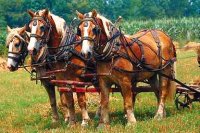
Hybridized domesticated horses
For thousands of years farmers and herders have been selectively breeding their plants and animals to produce more useful hybrids. Information technology was somewhat of a hit or miss process since the bodily mechanisms governing inheritance were unknown. Knowledge of these genetic mechanisms finally came as a effect of careful laboratory breeding experiments carried out over the last century and a half.
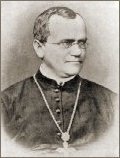
Gregor Mendel
1822-1884By the 1890's, the invention of ameliorate microscopes allowed biologists to discover the basic facts of prison cell sectionalization and sexual reproduction. The focus of genetics

Common edible peas
While Mendel's inquiry was with plants, the basic underlying principles of heredity
Through the selective cross-breeding of common pea plants (Pisum sativum) over many generations, Mendel discovered that sure traits testify up in offspring without whatsoever blending of parent characteristics. For example, the pea flowers are either imperial or white--intermediate colors do not announced in the offspring of cross-pollinated pea plants. Mendel observed seven traits that are easily recognized and apparently only occur in one of two forms:
1. flower color is purple or white 5. seed color is xanthous or light-green 2. flower position is axil or terminal six. pod shape is inflated or constricted three. stem length is long or brusk 7. pod color is yellow or dark-green iv. seed shape is circular or wrinkled This ascertainment that these traits do non show up in offspring plants with intermediate forms was critically important because the leading theory in biology at the time was that inherited traits blend from generation to generation. Almost of the leading scientists in the 19th century accepted this "blending theory." Charles Darwin proposed another equally wrong theory known equally "pangenesis"
Mendel picked common garden pea plants for the focus of his enquiry because they tin can be grown easily in large numbers and their reproduction can be manipulated. Pea plants have both male and female reproductive organs. Equally a result, they tin can either self-pollinate themselves or cross-pollinate with another plant. In his experiments, Mendel was able to selectively cross-pollinate purebred
Reproductive
structures of
flowers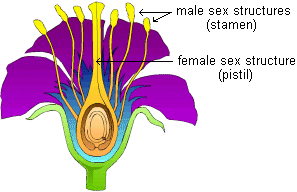
In cross-pollinating plants that either produce yellow or green pea seeds exclusively, Mendel constitute that the first offspring generation (f1) ever has yellow seeds. However, the following generation (f2) consistently has a three:1 ratio of yellow to green.
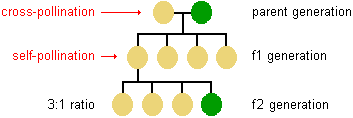
This 3:ane ratio occurs in later generations as well. Mendel realized that this underlying regularity was the key to agreement the bones mechanisms of inheritance.
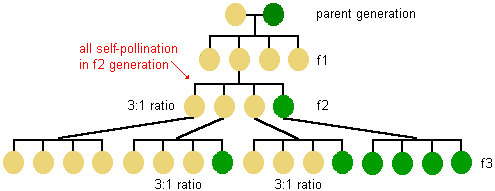
He came to three important conclusions from these experimental results:
1. that the inheritance of each trait is determined past "units" or "factors" that are passed on to descendents unchanged (these units are at present called genes 2. that an individual inherits ane such unit from each parent for each trait 3. that a trait may not show upwards in an individual only can still exist passed on to the side by side generation. It is important to realize that, in this experiment, the starting parent plants were homozygous
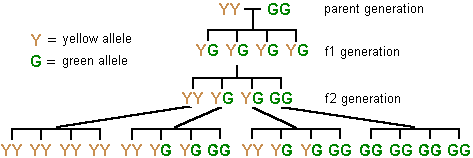
Note that each of the f1 generation plants (shown above) inherited a Y allele from one parent and a G allele from the other. When the f1 plants breed, each has an equal chance of passing on either Y or K alleles to each offspring.
With all of the 7 pea plant traits that Mendel examined, ane form appeared dominant over the other, which is to say information technology masked the presence of the other allele. For instance, when the genotype for pea seed color is YG (heterozygous), the phenotype is xanthous. However, the dominant yellow allele does non modify the recessive green i in whatsoever way. Both alleles can be passed on to the next generation unchanged.
Mendel's observations from these experiments tin can be summarized in two principles:
1. the principle of segregation ii. the principle of contained array According to the principle of segregation , for whatsoever detail trait, the pair of alleles of each parent separate and but one allele passes from each parent on to an offspring. Which allele in a parent's pair of alleles is inherited is a matter of take chances. Nosotros now know that this segregation of alleles occurs during the process of sex cell formation (i.east., meiosis
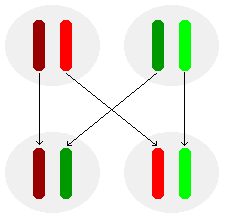
Segregation of alleles in the production of sexual practice cells
According to the principle of independent assortment , different pairs of alleles are passed to offspring independently of each other. The result is that new combinations of genes nowadays in neither parent are possible. For case, a pea plant'due south inheritance of the ability to produce purple flowers instead of white ones does not make it more likely that it will too inherit the ability to produce yellow pea seeds in contrast to light-green ones. Besides, the principle of independent assortment explains why the human inheritance of a particular eye color does non increase or decrease the likelihood of having 6 fingers on each manus. Today, we know this is due to the fact that the genes for independently assorted traits are located on different chromosomes
These two principles of inheritance, along with the understanding of unit of measurement inheritance and potency, were the beginnings of our mod scientific discipline of genetics. However, Mendel did not realize that there are exceptions to these rules. Some of these exceptions volition exist explored in the 3rd section of this tutorial and in the Constructed Theory of Evolution tutorial.
By focusing on Mendel as the father of genetics, modernistic biological science oft forgets that his experimental results likewise disproved Lamarck'south theory of the inheritance of caused characteristics described in the Early Theories of Evolution tutorial. Mendel rarely gets credit for this because his work remained essentially unknown until long afterwards Lamarck's ideas were widely rejected equally being improbable.
NOTE: Some biologists refer to Mendel'south "principles" every bit "laws".NOTE: I of the reasons that Mendel carried out his breeding experiments with pea plants was that he could observe inheritance patterns in up to two generations a yr. Geneticists today usually behave out their breeding experiments with species that reproduce much more rapidly and so that the corporeality of time and money required is significantly reduced. Fruit flies and leaner are commonly used for this purpose now. Fruit flies reproduce in virtually ii weeks from birth, while bacteria, such as E. coli plant in our digestive systems, reproduce in but 3-v hours.
Copyright � 1997-2013 past Dennis O'Neil. All rights reserved.
analogy credits
Russian translation
chambersproutiting1968.blogspot.com
Source: https://www2.palomar.edu/anthro/mendel/mendel_1.htm
0 Response to "Gregor Mendel Genetics on a Baby From the Eye Colors"
Postar um comentário